
IP Transport
Complete lifecycle management for IP transport networks, from address management and provisioning to fault management.
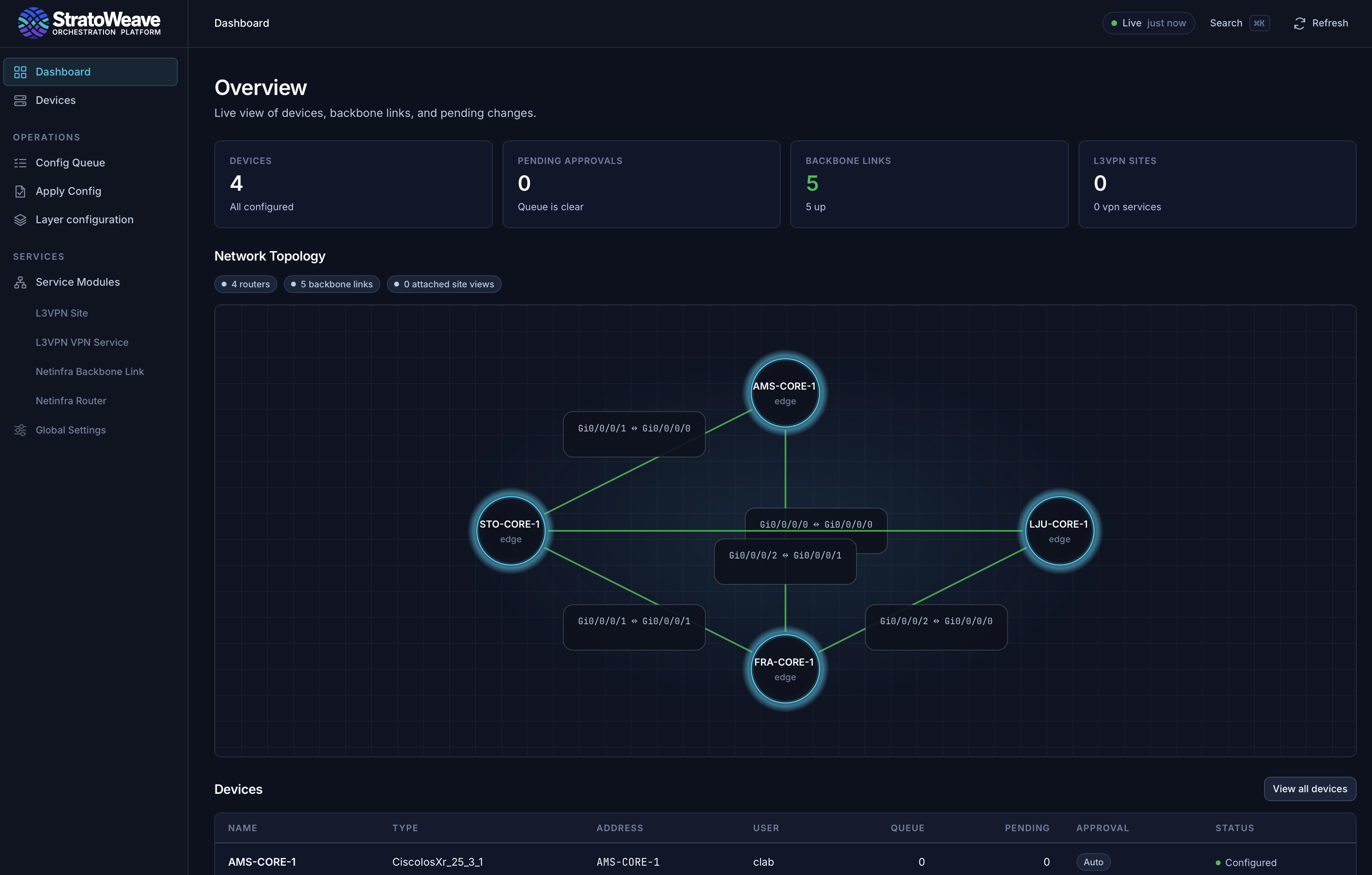
Whether you operate an MLPS, IP-only, or hybrid network, StratoWeave provides a foundation for managing your IP transport. Its reference implementation, the Somewhat Realistic Service Provider Orchestrator (SORESPO), demonstrates how to model and configure a backbone network with multiple routers and links. It also shows how to gather and correlate operational state from across the network.
Keep backbone configuration consistent
Define routers and the links between them. Layered transforms derive interface addressing, routing configuration, and peering from those definitions. In the reference implementation, router intent drives loopback addresses and iBGP peering, while backbone links drive the configuration of both endpoints. Network-wide settings can flow through the same layers to all participating routers.
Work across vendor boundaries
Keep the network model separate from device-specific details. SORESPO provides examples for Cisco IOS XR, Juniper Junos, and Nokia SR Linux. Its transforms configure IS-IS and iBGP, with MPLS/LDP transport for the Cisco and Juniper examples and VXLAN with BGP EVPN for Nokia. You can adapt the models and transforms to the addressing, platforms, and policies your network requires.
Operational state for the whole network
Each StratoWeave transform can subscribe to operational state from the services or devices below it. For example, a transform that configures a router's interfaces can subscribe to the operational state of those interfaces, while a transform that configures a backbone link can subscribe to the operational state of both endpoints.
Device telemetry is collected by StratoWeave's streaming telemetry framework, including gNMI, YANG push, and SNMP. As a service developer, all you must express are the operational data paths you want to subscribe to. The framework handles the rest, including establishing the subscription, receiving updates, and converting them into a format that is easy to consume in your transforms.
Provide complete visibility into the operational state of your network, including complete correlation of individual data points or events into a service-oriented view.