
VPN Services
Accept customer connectivity requests and coordinate the network configuration behind each VPN. Report on operational state and SLA compliance.
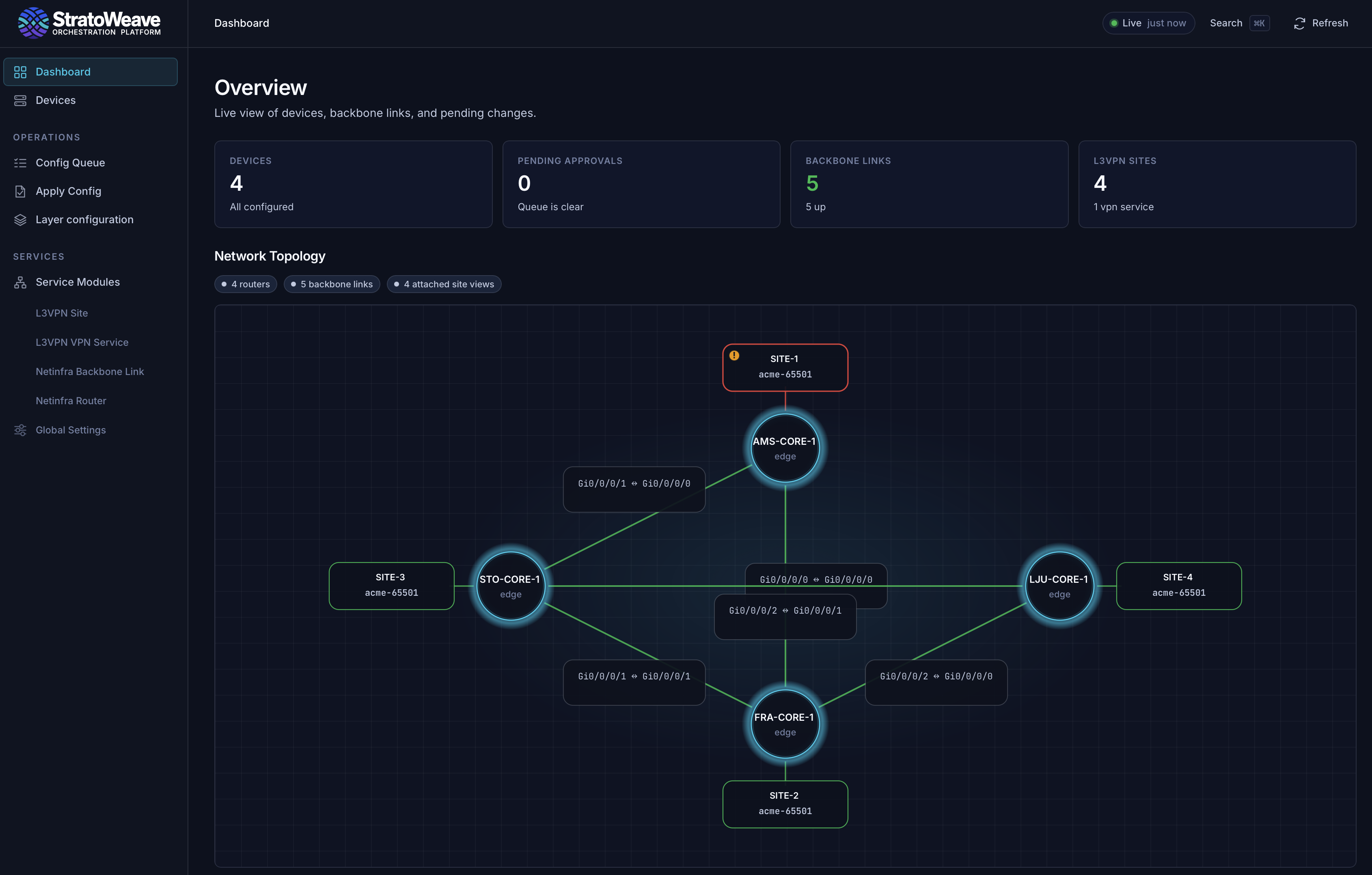
Business connectivity over L2 or L3 VPNs is a common service for service providers. Customers expect self-service ordering, fast provisioning, and reliable operation. StratoWeave helps you model the service your customers want, translate it into network resources, and keep its configuration aligned as customer requirements change.
Support IETF standard service models
The IETF RFC899 L3VPN and RFC 8466 L2VPN service models, provide a standardized way to express customer connectivity. StratoWeave's multilayer architecture lets you expose those models in your service catalog to your BSS or customer portal while handling the complete implementation (OSS) on a single open-source platform. You can also extend the models to meet your unique sevice offerings, such as adding a service-level agreement (SLA) to the L3VPN model.
Keep service changes consistent
Separate customer intent from the details of each device. The same layered approach maps L3VPN services onto the reference implementation's MPLS-based and EVPN/VXLAN-based networks. When service intent changes, StratoWeave updates the configuration owned by its transforms. Removing intent removes that owned configuration, giving the service one declarative lifecycle across its participating devices.
Expose SLA compliance and operational state
Avoid inconsistencies between service provisioning and network monitoring / observability platforms. In StratoWeave, the operational state of a service lives right inside the same set of transforms that provision it.
Collect telemetry from the network and correlate it layer by layer. StratoWeave's transform actors can combine the state of multiple devices and related services into a single service health view for your customers.